

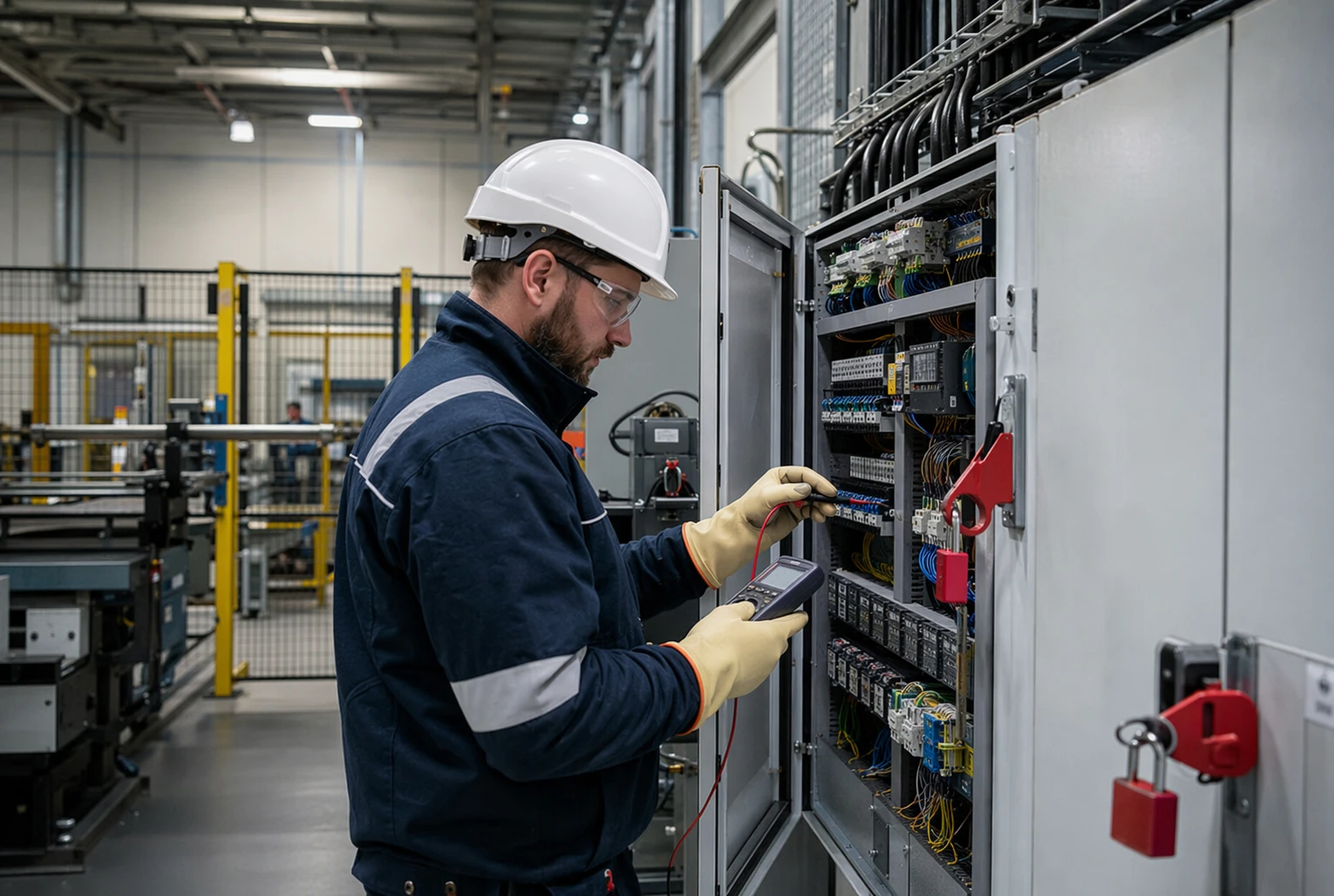
Maintenance and Repair for Commercial Properties
Regulation 4 of the Electricity at Work Regulations 1989 requires electrical systems to be maintained where necessary to prevent danger. HSE also reports that around 1,000 electrical accidents at work are reported each year, with approximately 25 resulting in death.
TEC provides electrical maintenance for businesses, facilities teams and property managers. Our electricians assess the fault, isolate affected equipment where required, complete appropriate repairs and test the system before it is returned to use.
Where a failure cannot be permanently resolved during the initial visit, we make the situation safe, explain any operating restrictions and set out the further remedial work required. Recurring faults may also indicate a need for wider testing, equipment replacement or a preventative maintenance programme.

What Is Reactive Electrical Maintenance?
It is work completed after an electrical problem has developed. Its immediate purpose is to remove danger, identify the cause and return the affected system to normal use where it is safe to do so.
Unlike preventative electrical maintenance, which is arranged before equipment fails, this type of work begins when a defect, breakdown or loss of supply is reported.
The service may include:
- Investigating tripping circuits or power loss
- Locating loose connections or damaged cabling
- Replacing failed electrical parts
- Restoring supplies to essential equipment
- Resolving distribution board problems
- Making burnt or heat-damaged accessories safe
- Assessing faults following water ingress
- Completing temporary safety measures before a thorough inspection
- Testing the affected circuit
- Recording findings and recommended follow-up work
Regulation 4 of the Electricity at Work Regulations 1989 requires electrical systems to be maintained, where necessary, to prevent danger so far as is reasonably practicable. The work must therefore do more than restore power. It should leave the affected system in a safe condition and support an appropriate maintenance schedule.
How Urgent Is Your Electrical Fault?
Answer four quick questions to receive general guidance on how promptly the fault should be assessed. Select every option that applies where multiple choices are allowed.
What Common Electrical Issues Require Attention?
Commercial properties can experience faults ranging from an isolated defect to a failure affecting an entire building.
Common examples include troubleshooting and energy-efficient upgrades.
- Repeated RCD or circuit-breaker trips
- Partial or complete power loss
- Burnt sockets, switches or connections
- Damaged cables and containment
- Failed general or emergency lighting
- Overheating distribution equipment
- Loose or deteriorated terminations
- Problems following a leak or flood
- Machinery supplies that stop working
- Unusual smells, heat, noise or visible damage
- Defective controls, contactors or isolators
- Problems identified during electrical testing
Failed emergency lighting, damaged wiring and overheating equipment require prompt inspection and reliable replacement components where necessary. Problems found during testing may also indicate the need for a broader maintenance review.
These events can affect offices, shops, schools, warehouses, factories and managed buildings. The correct response depends on the environment, the equipment affected and the immediate level of risk.
What Does Our Reactive Maintenance Service Include?
TEC follows a structured process rather than treating every callout as an isolated quick fix.
Initial Assessment and Triage
The first stage is to gather clear information about the fault. This includes when it began, which areas are affected, whether there are signs of heat damage and whether critical systems have stopped working.
The call is prioritised according to:
- Risk to occupants
- Extent of the outage
- Type of building
- Equipment affected
- Effect on productivity
- Known access restrictions or hazards
Safe Isolation and Fault Diagnosis
On arrival, the engineer assesses the immediate risk and isolates the affected supply where required.
HSE guidance states that work should be carried out with electrical systems dead wherever possible. Suitable precautions must also prevent the supply from being re-energised while work is underway.
The engineer then uses suitable testing equipment and a methodical fault-finding process to trace the cause. This helps avoid replacing parts unnecessarily or restoring a circuit without understanding why it failed.
Checks may include:
- Circuit continuity
- Insulation resistance
- Protective devices
- Connections and terminations
- Distribution equipment
- Connected loads
- Control equipment
- Earthing arrangements
Electrical injuries can occur across a wide range of voltages, and even supplies below 230 volts can be dangerous in certain circumstances. Correct isolation and verification are therefore essential before repair work begins.
Repairs, Testing and Reporting
Once the cause has been identified, the affected component may be adjusted, repaired or replaced.
Where a permanent solution cannot be completed immediately, the engineer will explain any temporary restrictions and the additional work required. Older equipment may need further assessment where compatible replacement parts are no longer readily available.
The affected system is checked before it is returned to use. TEC can then provide a clear record covering:
- The reported fault
- Findings from the visit
- Work completed
- Items replaced
- Relevant test results
- Remaining limitations
- Recommended next steps
Test results help confirm whether the affected circuit can be returned to service safely and provide useful evidence for future inspection and maintenance work.
The completed report also gives the responsible person, facilities team, landlord or property manager a clear record of the fault and the action taken.
Prepare for an Electrical Maintenance Callout
Select the information you already know and add any useful details. The checklist will create a clear fault summary that can be sent directly to TEC with your enquiry.
Examples of Reactive Electrical Work
The response required will vary between buildings and sectors, so the work must be adapted to the affected system, site risks and operating requirements.
Commercial and Office Electrical Faults
Tripping circuit in an office
A circuit supplying office equipment repeatedly trips during working hours. The engineer isolates the affected area, checks the connected loads and tests the circuit to establish whether the cause is faulty equipment, cable damage or excessive demand.
Damaged cabling in a commercial unit
A cable is damaged during building work or while equipment is being moved. The area is isolated, the extent of the damage is assessed, and the cable is repaired, replaced or rerouted to provide more suitable mechanical protection.
Warehouse and Industrial Electrical Faults
Distribution failure in a warehouse
A protective device or connection fails and interrupts power to part of a warehouse. The affected section is made safe, the source of the fault is traced, and suitable parts are fitted before the supply is checked and restored.
Machinery supply failure
A production machine or fixed item of equipment loses power unexpectedly. The engineer checks the supply, local isolator, controls and protective devices to determine whether the fault is within the fixed electrical system or the connected machinery.
The UK's #1 Reactive Electrical Contractor
What Are the Different Types of Electrical Maintenance?
Most businesses benefit from combining several maintenance strategies rather than relying on one approach.
Reactive and Preventative Maintenance
Reactive maintenance can often lead to more major repairs if not managed properly.
Work begins after a fault has occurred. It is suitable for unexpected problems that require investigation, isolation or restoration.
Preventative maintenance
Preventative maintenance is completed at agreed intervals to reduce the risk of breakdowns. It may involve visual checks, testing, cleaning, tightening connections and changing components before significant deterioration occurs.
Planned, Condition-Based and Predictive Maintenance
Planned maintenance
This covers work arranged in advance following test results, manufacturer guidance or known defects that do not require an immediate callout.
Condition-based maintenance
The condition of equipment is assessed through checks, measurements or operating data. Further work is then arranged when signs of deterioration are found.
Predictive maintenance
Predictive methods use monitoring data and performance trends to anticipate when a failure may occur. This can be valuable for critical industrial equipment where an unexpected shutdown would cause significant disruption.
A comprehensive maintenance strategy may use several of these methods depending on risk, site use, available records and the importance of connected equipment.
Do You Need Reactive or Planned Electrical Maintenance?
Answer four quick questions to see which type of electrical maintenance may be most appropriate for your premises.
Advantages of Electrical Maintenance
Even businesses with strong preventative measures still need support when an unexpected fault occurs.
The main advantages include:
- Prompt attention to unexpected faults – dangerous defects can be assessed without waiting for a future service visit.
- Restoration of essential services – important equipment and circuits can be returned to use as soon as circumstances safely allow.
- Focused expenditure on compliant electrics can yield significant long-term savings. – attention is directed towards the area that has failed.
- Flexible response – the work can be adapted around the building, occupancy and affected equipment.
- Useful diagnostic evidence – findings can expose recurring weaknesses and inform future decisions.
- Reduced disruption – early intervention may prevent a local fault from affecting a wider part of the building.
Disadvantages of Reactive Maintenance
Responding after a breakdown is sometimes unavoidable, but relying on reactive repairs alone has several limitations, making proactive maintenance essential.
- Unplanned downtime – The response begins after the affected system has already stopped working. This can interrupt production, customer service, heating, security or communications, highlighting the value of regular maintenance for critical systems.
- Greater disruption – Isolation and fault-finding may need to take place while the building is occupied or during an important production period.
- Limited preparation – Specialist access equipment or suitable parts may not be immediately available. An initial safety intervention may therefore be required before permanent work can be arranged.
- Secondary damage – An unresolved loose connection, overloaded circuit or damaged cable may place additional stress on nearby equipment.
- Less predictable costs – Scheduled work can be budgeted and coordinated in advance. Unexpected faults are harder to forecast.
- Repeat callouts – Changing one failed item may not address a wider problem elsewhere in the system. Recurring faults should trigger a broader review rather than repeated short-term fixes.
Reactive work is therefore most effective when combined with routine inspection, planned electrical maintenance and preventative measures.
How TEC Manages Reactive Maintenance Challenges
Electrical faults often occur in occupied premises where access, safety and operational continuity must all be considered.
Maintaining Operations During Repairs
Where practical, TEC can isolate the affected section while allowing other areas to remain operational. Attendance may also be coordinated around shifts, deliveries, opening hours or production requirements.
This helps reduce disruption while ensuring the affected area remains properly controlled and compliant.
Access, Records and Obsolete Equipment
Electrical equipment may be positioned above ceilings, within service risers, around machinery or at height. Suitable access arrangements are considered before intrusive work begins.
Older buildings may also have incomplete drawings, unclear circuit labels or undocumented alterations. Engineers must test and trace the system rather than relying on inaccurate information.
Where older equipment no longer has a suitable direct replacement, TEC can assess whether an approved alternative is available or whether part of the system requires upgrading.
Coordination and Minimal Disruption
The cause of a fault may involve water ingress, mechanical equipment, fire systems, controls or damage created during construction.
TEC communicates its findings clearly so that relevant specialists understand what further action is required. Repairs can be organised through phased isolation, temporary restrictions and regular communication with the person responsible for the building.
The work must not be rushed, but it can be carefully planned to reduce its effect on staff, tenants, customers and production.
Safety Standards and Legal Responsibilities
People with appropriate training, knowledge and experience must manage commercial electrical work.
HSE guidance states that specialist electrical work should only be undertaken by trained and competent people following suitable procedures.
HSE reports that around three workers are electrocuted each year during refurbishment work on commercial and domestic buildings. Incidents can involve qualified electricians as well as other trades working on or close to electrical equipment.
Across all types of workplace accidents, employers reported 209 non-fatal injuries for every 100,000 employees in Great Britain during 2024/25. This is not an electrical failure rate, but it provides wider context for the importance of properly managed workplace safety procedures.
TEC’s approach includes:
- Risk-based triage
- Suitable isolation procedures
- Appropriate testing equipment
- Qualified personnel
- Clear communication with the dutyholder
- Checks before systems return to use
- Records of completed work
- Advice on outstanding risks
HSG85 guides people who carry out, supervise or manage work on or near electrical equipment. It covers the key considerations for establishing safe working practices.
Choosing a Reactive Electrical Maintenance Contractor
Fast attendance is useful, but correct diagnosis and safe working are more important.
Before appointing a provider, ask:
- Who will attend and what experience do they have?
- Is round-the-clock support available?
- How are urgent calls prioritised?
- How will the affected area be made safe?
- Can the team work around our opening hours?
- Will we receive a written report?
- Can suitable parts be sourced?
- Can follow-up remedial work also be completed?
- Can the company support multiple locations?
- Will relevant testing and certification be supplied?
TEC is a NICEIC Approved Contractor supporting businesses, facilities teams, landlords and organisations with commercial electrical services. Our process is designed to provide skilled workmanship, clear documentation, and dependable follow-up from the first report through to completion, ensuring compliance with safety standards.
UK-Wide Service
Why Choose Us
TEC provides fault response and repairs as part of a wider range of commercial and industrial services.
Clients benefit from skilled technicians who provide thorough troubleshooting and energy-efficient solutions.
- Qualified and experienced electricians
- Prompt callout support
- Safe isolation and methodical fault-finding
- Commercial and industrial experience
- Clear reports and recommendations
- Ongoing servicing options
- Testing and certification
- Solutions tailored to the building
- Support for occupied and active sites
- A focus on minimal disruption
Next Steps
Get in Touch
We do not simply restore a circuit and leave without explanation; we ensure all work is compliant and documented. Our team identifies what happened, completes the appropriate work and advises whether further action is needed to improve safety, reliability or efficiency.
Frequently Asked Questions
Answers to common questions about reactive electrical maintenance, fault-finding, repairs, downtime and ongoing support for commercial and industrial premises.
It begins when an electrical fault is reported. The affected system is assessed, isolated where necessary and tested to identify the cause. Suitable repairs are then completed before the system is checked and returned to use.
Reactive work begins following an unexpected fault. Planned work is arranged in advance to inspect, service or improve an electrical system before a breakdown occurs.
Efficient diagnosis can reduce the time required to locate the cause and establish a safe solution. Follow-up recommendations may also help prevent the same fault from returning.
The technician will make the situation safe, explain any restrictions and identify the materials or additional work required for a permanent repair. Unsafe equipment should not be returned to use simply to provide a temporary restoration.
Yes. Repeated trips, overheating or equipment failures can indicate an underlying issue. Broader testing or a review of the affected system may be recommended.
Yes. TEC can use the findings from the callout, inspection or EICR to recommend suitable testing, servicing or improvements that help reduce future faults and support continued compliance with relevant safety standards.
REACTIVE ELECTRICAL AVAILABLE THROUGHOUT:
- Avon
- Bedfordshire
- Berkshire
- Buckinghamshire
- Cambridgeshire
- Cheshire
- Cornwall
- Cumbria
- Derbyshire
- Devon
- Dorset
- Durham
- Essex
- Gloucestershire
- Greater London
- Hampshire
- Herefordshire
- Hertfordshire
- Isle of Wight
- Kent
- Lancashire
- Leicestershire
- Lincolnshire
- Merseyside
- Norfolk
- Northamptonshire
- Northumberland
- Nottinghamshire
- Oxfordshire
- Rutland
- Schools
- Shropshire
- Somerset
- Staffordshire
- Suffolk
- Surrey
- Sussex
- Tyne and Wear
- Warwickshire
- West Midlands
- Wiltshire
- Worcestershire
- Yorkshire