Key takeaways
An Electrical Installation Condition Report (EICR) will show the condition of the fixed electrical installation at the time of inspection. It does not however guarantee that no further problems will arise in the future.
In England there are specific electrical safety rules for the vast majority of privately rented property. Those rules don’t require a five year EICR for commercial property.
Commercial landlords, tenants and property managers all have to agree as to who is responsible for each individual electrical installation. The lease may apportion the work but it in no way removes the relevant legal duties.
If an EICR identifies any urgent issues or recommends further inspection(s) then act on the report, deal with the urgent issues and maintain proper records of any follow up work.
Store the reports, the inspection dates, the responsibility agreements and the repair records all in one place so that the right person can act before a problem is simply missed.
Introduction: EICR responsibilities for landlords
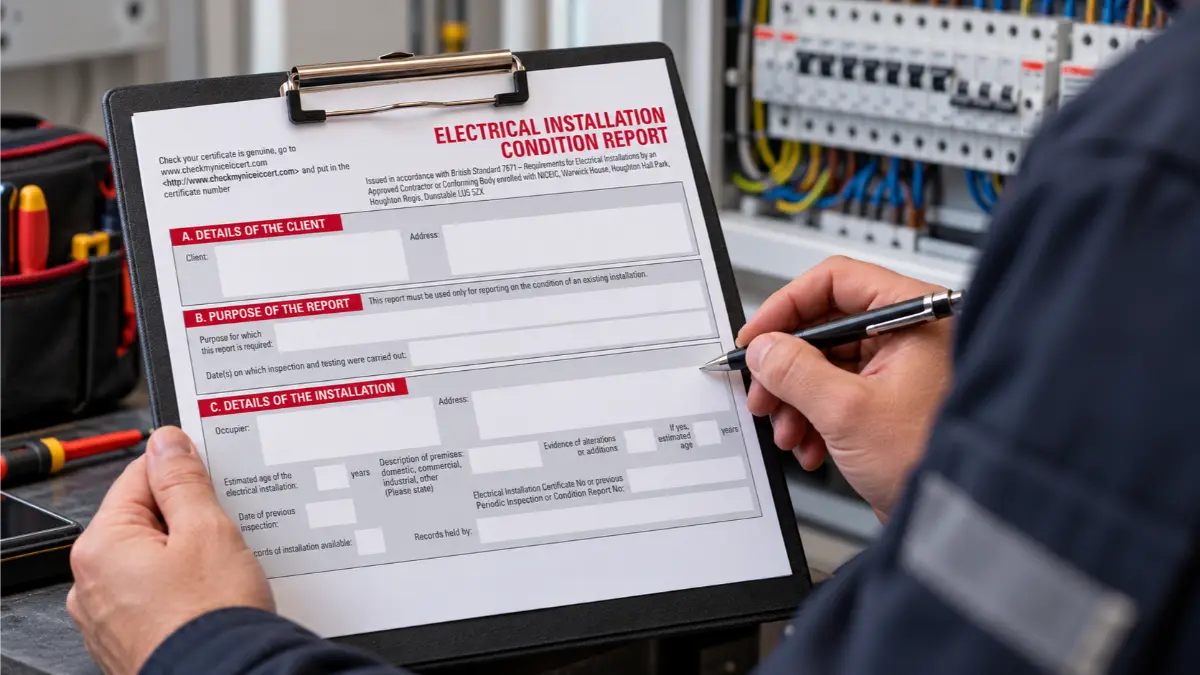
An Electrical Installation Condition Report (EICR) is a formal check and test of the fixed electrical installations within a building. This will note all of the conditions that were noted during the inspection date and identify any defective items, potential hazards or suggested improvements.
The first thing landlords need to consider is the type of property they have. The Electrical Safety Standards in the Private Rented Sector (England) Regulations 2020 set out specific duties for most private rental properties. However, there is a separate regulatory regime covering commercial properties. There is currently no one rule that requires each commercial landlord to carry out an EICR at the same frequency.
This Guide explains why there is a difference; provides guidance on determining which party has responsibility; details what is covered in an EICR and how to record and act upon your findings. The guide has been written for residential and commercial landlords, property managers and responsible persons.
What is an electrical installation condition report?
An EICR checks the fixed electrical installation (i.e. the wiring, circuits, distribution boards, sockets, lighting circuits, earthing and protective devices). The report will explain the condition found and will note any items which require attention.
Lots of people refer to it as an ‘EICR certificate’ but it’s in fact a report on the condition of the installation. It should be read in conjunction with any electrical installation certificates and any records of subsequent repairs.
Which document covers what? Select one to compare.
An EICR is a routine inspection of an existing installation. It reports on the condition of the fixed wiring at the time of inspection.
An Electrical Installation Certificate (EIC) is normally issued following new installation work or major alterations. Keep it with the property's electrical records.
PAT testing is concerned with portable appliances rather than the fixed wiring that an EICR looks at. Arrange it separately where appropriate.
Do commercial landlords need an EICR?
There isn’t a required time frame in legislation for every commercial building to undergo an EICR (electrical installation condition report). The Electricity At Work Regulations 1989; regulation 4(2), states that electrical systems should be kept in safe working order by way of maintenance as may be necessary to prevent danger and, so far as is reasonably practicable. Therefore, there is no specific EICR frequency for all commercial buildings, nor does it require every commercial business to have an electrical system inspected every five years.
An EICR is one way to assess and record the condition of a fixed electrical installation, and it may form part of a wider electrical safety and fixed-wire testing programme. The appropriate inspections and their frequency should reflect the installation, how and where it is used, its condition, the risks present, maintenance history and recommendations in the latest report. HSE guidance on electrical maintenance says the checks and testing needed depend on the equipment, environment and results of previous checks.
Commercial landlords should not assume that the five-year interval for covered residential tenancies applies automatically to commercial premises.
Residential landlord rules and commercial duties
The Electrical Safety Standards in the Private Rented Sector and Social Rented Sector (England) Regulations 2020 apply to certain residential tenancies in England (subject to the scope and exclusions of the Regulations). The landlord must have a qualified person carry out a check and test of the electrical installation at least every 5 years, or more frequently if the most recent report requires it. The responsibilities will vary depending on the tenancy and the type of property in question (e.g. a house in multiple occupation).
The landlord must get a report from a competent and qualified person and keep it until the next inspection is due. Existing tenants must be given a copy within 28 days of the inspection and testing. A new tenant must be given a copy prior to occupation. If a prospective tenant writes to request a copy it must be provided within 28 days. If the local authority makes a written request for a copy it must be provided within 7 days. These requirements apply to landlords and tenancies within the scope of the regulations (including existing tenancies).
If the report identifies any remedial work or further inspection/testing required then the landlord must have a qualified person carry out that work within 28 days of the inspection/testing (or sooner if the report states that it should be done sooner). The landlord is of course responsible for electrical safety throughout the tenancy.
Once the work/investigation is complete the landlord must obtain written confirmation from a competent person as to whether the electrical safety standards have been met or whether further work is required. The landlord must provide this confirmation and a copy of the report to the current tenants and the local housing authority within 28 days of the work being completed.
These rules apply to certain residential tenancies in England (subject to their scope and any exclusions). There is no set EICR interval for commercial properties. You would need to look at the relevant health and safety duties and the way the site is run. For certain breaches of the rules, the local authority can issue a fine of up to £40,000 via the statutory enforcement process.
Who is responsible for electrical safety in commercial premises?
Responsibility for an issue will depend upon who employs personnel working at the premises, who has control of the work or electrical system, what the terms of the lease state, and how the parties actually conduct their maintenance activities. The lease may identify which party to inspect and/or repair certain items. However, it does not automatically relieve one party of any legal obligations they have as per statute with respect to those same issues.
Consider each of these separately (tenant space, landlord controlled equipment, shared spaces) and in a multi-lease situation, a tenant may be responsible for the maintenance of equipment in their own unit but the landlord/leasing agent may be responsible for the maintenance of the common areas and the shared distribution equipment. Check your lease and check how things actually work.
Record the agreed arrangements in writing. Make clear who will arrange inspections, who will provide access, who will receive reports, who will authorise remedial work and how unresolved safety concerns will be escalated.
What does an EICR inspection cover?
The scope of EICR inspections and electrical safety testing should be agreed with the inspector before work starts. A typical inspection of fixed electrical installations may include:
- The main intake and distribution boards
- Fixed wiring and circuits serving plug sockets and light fittings
- Protective devices, such as circuit breakers and RCDs
- Earthing and bonding
- Permanently connected equipment, where included in the agreed scope
An EICR does not usually test portable appliances or other electrical equipment such as kettles, laptops or plug-in office equipment. Where the landlord or business provides electrical appliances, consider separate visual checks or in-service inspection and testing based on the equipment, its use and the risk. Keep appliance records separate from the fixed-installation report.
The report should identify any areas or circuits that could not be inspected or tested and explain the inspection’s limitations. Record when electrical installations are inspected and tested so the next inspection can be planned. Where a landlord commissions fixed wire testing, confirm whether the report covers the whole installation or only named areas. Ask the inspector to clarify any exclusions before relying on the report as evidence for the whole property.
Choosing a qualified and competent electrician
An EICR should be completed by someone with suitable knowledge, training and experience in inspection and testing. Before appointing a qualified electrician or electrical inspector, ask for:
- Evidence of relevant qualifications and inspection-and-testing experience
- Confirmation that their experience matches the type of property and installation
- Professional registration or certification-scheme details, where applicable
- The proposed inspection scope, access requirements and any limitations
- Confirmation of how findings and any urgent risks will be reported
A qualified and competent electrician or engineer must be able to assess the electrical installation, recognise electrical hazards and explain what the report’s observations mean. Ask whether they are a member of a competent person scheme or other relevant certification scheme, and request evidence that their inspection and testing experience fits the property.
Do not select a contractor solely because they offer a quick inspection; the report needs to be suitable for the installation and the decisions you have to make.
What happens during an EICR inspection?
The inspector will typically start by asking questions about the electrical system; viewing your documentation related to the electrical system and agreeing upon an entry strategy to gain access to all of the required areas.
Access to the Distribution Boards, Electrical Cupboards etc. will be required by the inspector.
The inspector can visually inspect the premises and perform an electrical test.
Please notify the inspector of any faults known to you, any recent modifications made to the premises and if there have been any previous reports. If there are any parts of the premises that are unavailable for inspection, please advise the inspector of this prior to commencement. Also, please confirm the limitations to access have been documented within the inspectors' report.
Some of these inspections require a brief switch off for a circuit. If this would affect how the tenant uses their equipment, impacts on business activities or persons within the premises, please ensure agreement from the tenant/ site manager prior to commencing.
The time and disruption depend on the size and complexity of the installation, its condition and the agreed scope. The inspection should be planned so the person controlling the site understands when circuits may be unavailable.
Understanding the EICR report
An EICR will set out what was inspected and will give an overall conclusion as to the inspection. It will contain recommendations as to what needs to be done in the case of any findings which are deemed unsatisfactory.
This in no way implies that all of your electrical installation has to be replaced. Please refer to the Inspection Scope, Limitations and Recommended Inspection Date prior to the next scheduled inspection. The Report is simply a statement of the condition of the Installation at the time of inspection and in no way is it a guarantee of safety for the duration of years until the next inspection.
The Observation Codes indicate the type of problem identified:
- C1: Danger present.
- C2: Potentially dangerous.
- C3: Improvement recommended.
- FI: Further investigation required.
Wherever a C1 or C2 finding is made, ask the Inspector to identify each defect (including any faulty wiring) and the action required to rectify it. Your EICR Report should clearly record the Observation and make the appropriate recommendations.
If you need any further information, see TEC’s EICR Code Guide for the full details on the C1/C2/C3/FI codes. If you’re at all unclear as to what the Inspector is reporting in terms of Risk, Recommend Action and Timeline, ask the Inspector for clarification. A C3 recommendation is not in the same category as a C1 or C2 which could indicate an Immediate or Potential Risk of Electric Shock or Fire.
An FI will require further investigation. Before you can leave an Observation Unresolved you must be 100% clear as to what the action/investigation is that is required.
What to do after an unsatisfactory EICR
Read the report at the earliest possible opportunity and look out for any immediate hazards, any required repairs or any further investigations that may be necessary.
Which type of property is the report for?
For commercial premises there is no 28 day rule. The person in charge must assess the risks, take reasonable steps to mitigate the risk and get the necessary repairs or investigations done as quickly as possible. If there is an immediate risk then obviously turn off the circuit/equipment in question until you've got some expert advice.
For residential properties in England the rule is to carry out any required repairs or investigations within 28 days or as soon as the report states.
Once the work is complete get the written proof and any required electrical certificates. Check that the issues identified in the original report have been rectified or that a further inspection is required. Update the property records and let the tenants/building users know of any ongoing restrictions or works.
Records landlords and property managers should keep
Keep a central record for each property or managed area, including when electrical installations are inspected and tested. Include:
- The latest EICR and its inspection scope
- The inspection date and recommended next inspection date
- The person or organisation responsible for the installation
- Lease or maintenance clauses that affect responsibility
- Any C1, C2, C3 or FI observations and their status
- Remedial-work evidence, certificates and written confirmation
- Access arrangements, communications and any limitations recorded by the inspector
For residential properties covered by the England regulations, retain and provide reports in line with the legal requirements. For commercial premises, keeping a clear record helps the relevant parties manage electrical safety and demonstrate what action they took.
Landlord EICR checklist
Before closing out an inspection, confirm that you have:
0 of 8 complete
Common questions about EICR for landlords
Does every commercial property legally need an EICR?
There is no prescribed legal time period for carrying out an EICR which applies to all commercial properties. The Electricity at Work Regulations 1989 require that electrical installations are maintained as necessary to prevent danger.
Those responsible for the electrical system should have suitable plans in place for inspection, testing and maintenance. An EICR is a written report on a fixed installation. How often you need one will depend on the property, its use and the risks involved.
Does a rented home in England need an EICR?
Most private rented homes in England are covered by the Electrical Safety Standards in the Private Rented Sector (England) Regulations 2020. The regulations were extended to social rented homes in 2025.
Check whether your tenancy and property are covered by these regulations and whether any transitional rules apply. Electrical installations will generally require inspection and testing every five years, or sooner if the last report requires an earlier inspection. The regulations and guidance set out what you need to do.
Is an EIC the same as an EICR?
No. An EIC records the results of new electrical installation work or a major alteration. An EICR records the condition of an existing installation at the time of an inspection. Keep both documents with the records for the property where they apply.
Does an EICR include PAT testing?
No. An EICR covers the fixed electrical installation within the agreed inspection scope. PAT testing and other in-service checks relate to electrical appliances and equipment. Arrange those checks separately where needed.
What if a tenant or occupier cannot provide access?
Get in contact with the tenant or occupier to arrange access and record your requests and agreements. If you’re a residential landlord, follow the relevant guidance and record the reasonable steps you take to arrange the inspection. For commercial properties, check the lease and follow the site management process. If you’re aware of any electrical hazards, pass this on to the appropriate person so they can deal with it.
Next steps for landlords and property managers
Go through the most recent report for each property and note the next inspection due date and who is responsible for repairs. If you’re unsure about the inspection scope, findings or responsibilities under the lease, seek advice from a qualified electrician or property adviser. Make sure applicable new electrical work is inspected, tested and documented.
TEC provides commercial electrical testing and EICR services. If you’d like to discuss an inspection for a commercial property or portfolio, please visit our Electrical Testing & Condition Reports service page.