Project overview
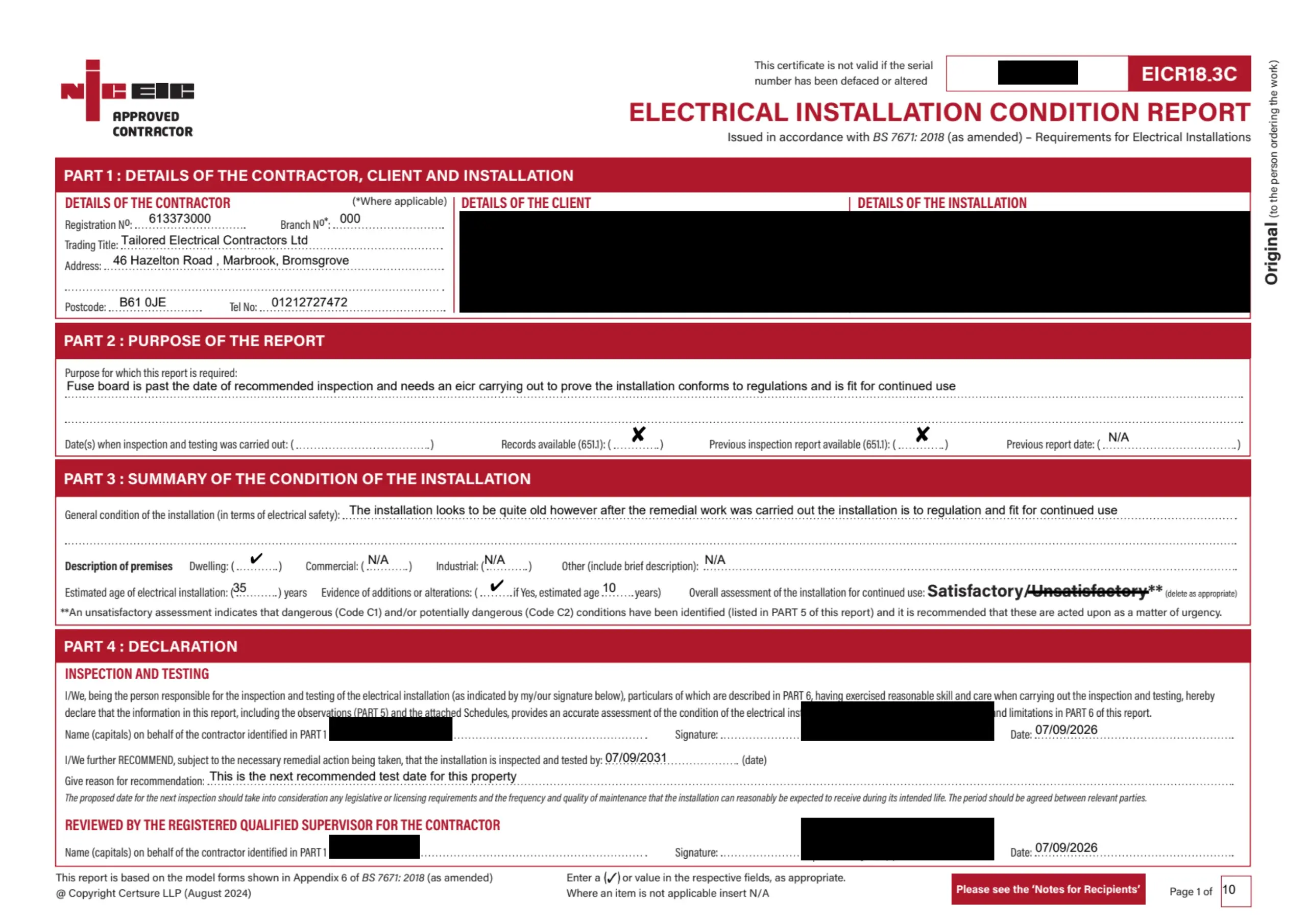
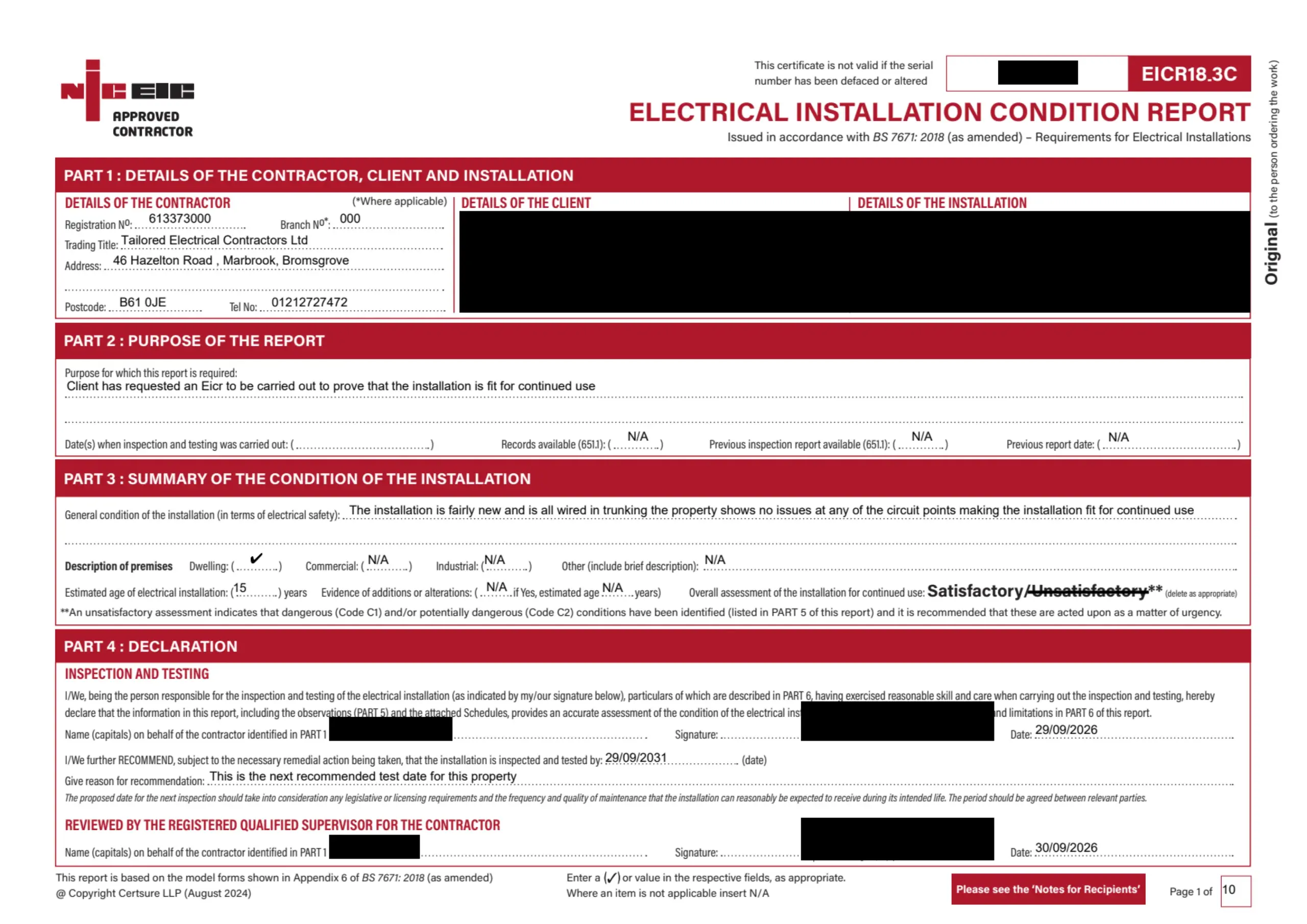
We have recently undertaken an EICR at a flat belonging to one of our commercial clients in Bromsgrove. Being NICEIC Approved Contractors, no. 613373000, means every report we carry out uses the relevant NICEIC forms. At roughly 15 years old, the electrical installation was assessed as satisfactory.
Our Managing Director, Ryan Ward, carried out the inspection and testing in September 2026. With 15 years’ experience and qualifications including City & Guilds Level 3 Electrical Installation, 2394 and 2395 Inspection and Testing, and the 18th Edition Wiring Regulations, Ryan ensures every assessment is thorough and reliable.
Client requirement
The client needed confirmation that the flat’s electrical installation was safe and suitable for ongoing use. An EICR provides a clear record of the condition of the fixed wiring and consumer unit, tested against BS 7671 standards, and gives a straightforward verdict for the client’s records.
Our role
The flat is supplied entirely from one consumer unit situated in the basement. All exposed wiring (in trunking), the intake and consumer unit, and main earthing and bonding arrangements were visually inspected by Ryan, who also identified the main CPC. He bonded the gas and water supplies and checked that all terminals and connections were secure.
Tests were carried out on the shower, all plug sockets in the kitchen, immersion heater, cooker, other plug sockets, storage heaters, and 2 lighting circuits. All appliances were disconnected from the supply, which was then isolated. Insulation resistance, polarity, continuity, earth fault loop impedance and RCD trip times were all tested by Ryan. All circuits gave a reading of 999 megohms or more on insulation resistance. Both RCDs operated correctly at 20 to 21 ms, that is, well below 300 ms.
Challenges
The water heater circuit could not be fully accessed, so continuity and earth fault loop impedance readings were not taken for that circuit. This limitation is clearly recorded in the report, so the client knows exactly what was and wasn’t covered. As with all EICRs, cables concealed in walls or under floors cannot be visually inspected, and this is also noted in the report.
Findings and recommendations
Two items came up as C3, which are improvement points only, so neither of them would affect the report’s Satisfactory rating.
Replacing the current RCDs with Type A would be a worthwhile improvement. The existing Type AC will operate on alternating current faults, whereas the Type A will also operate on pulsating direct current, to which the installation may well be susceptible through various electronic loads.
Adding a Surge Protective Device would bring further benefit by restricting over-voltage to the installation and the equipment it supplies.
We provided a quotation for the improvements suggested.
Outcome
The installation was found to be satisfactory and may remain in service. A comprehensive report has therefore been issued to the client, listing all circuits and test results and recommending September 2031 for re-testing.
If you need an EICR for a flat or any other property, let us know about your site and we’ll advise on the best next steps. Contact us on 0121 272 7472 to discuss your requirements.