

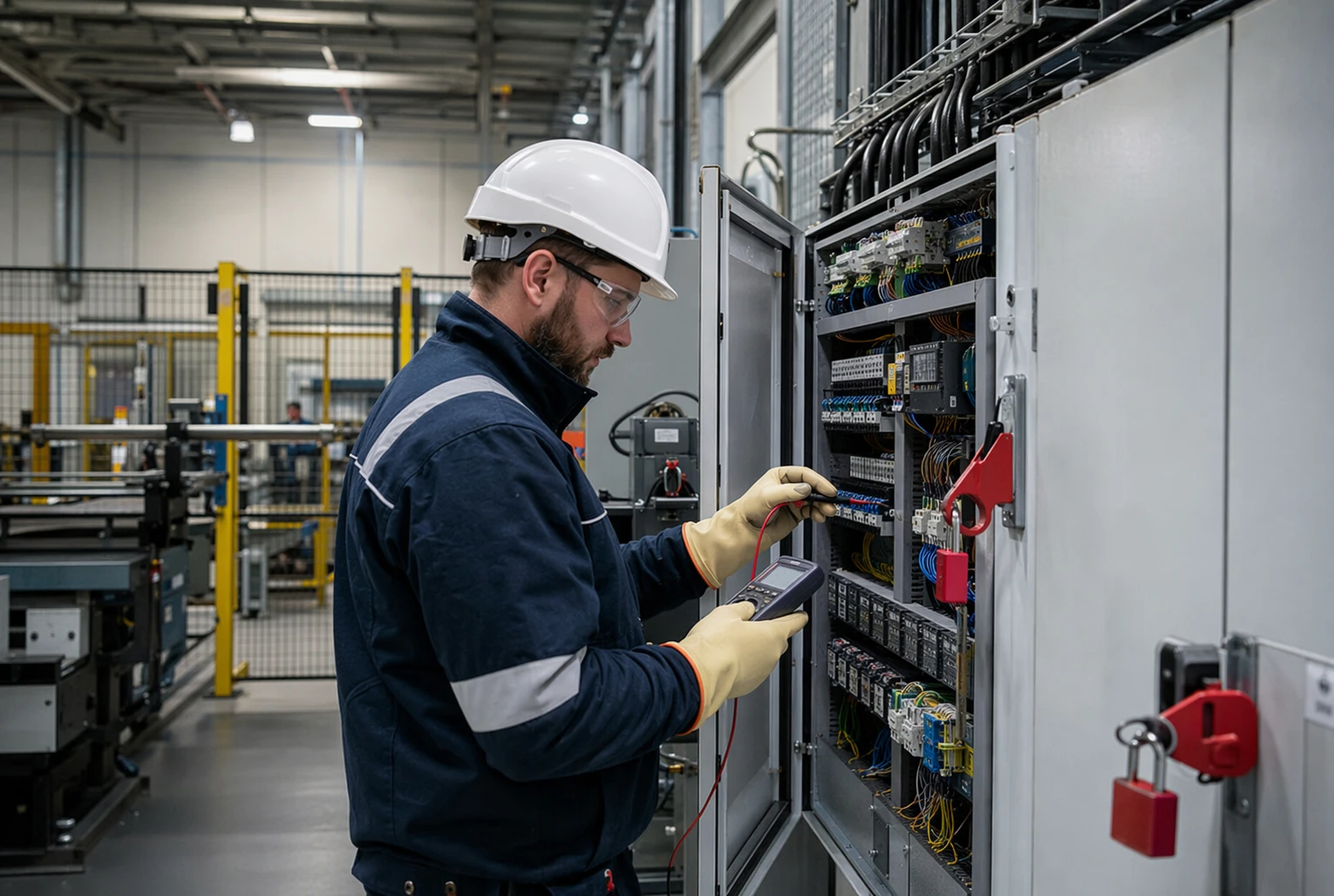
We help clients keep fixed wiring, lighting, distribution equipment and power supplies in reliable working order. Each programme is developed around the condition of the installation, the way the site operates and the level of support required.
Routine inspections can reveal wear, damage, overheating and other concerns before they lead to an unexpected failure. They also give facilities teams, landlords and responsible persons a clearer understanding of the installation and any work that should be prioritised.
From fixed wire testing and scheduled inspections to remedial work, TEC provides a structured service that supports electrical safety, compliance and operational continuity.

Routine Maintenance for Commercial and Industrial Premises
Planned maintenance gives commercial and industrial organisations greater control over electrical faults, repairs and shutdowns.
Modern workplaces depend on electricity for lighting, machinery, communications, security, production equipment and essential building functions. When maintenance is left until something fails, the consequences may include power outages, emergency call-outs, restricted working areas, lost production and higher repair costs.
An agreed programme allows inspections and repairs to be arranged around opening hours, shift patterns, tenant access and operational priorities.
TEC works with property managers, facilities teams, landlords, engineers and site operators to establish an appropriate scope and visit frequency.
How Urgent Is Your Electrical Fault?
Answer four quick questions to receive general guidance on how promptly the fault should be assessed. Select every option that applies where multiple choices are allowed.
What Is Planned Electrical Maintenance?
It is the organised inspection, testing and upkeep of electrical infrastructure at agreed intervals.
Its purpose is to identify deterioration, loose connections, overheating, damaged accessories, overloaded circuits and other concerns before they cause a wider problem.
The scope may include:
- Visual inspection of wiring and accessories
- Fixed wire testing and EICRs
- Distribution board and circuit checks
- Lighting and emergency lighting inspections
- Testing of switches, sockets and protective devices
- Machinery supply checks are essential for ensuring compliance with electrical services standards.
- Replacement of worn components
- Minor remedial work
- Recommendations for future improvements
The Health and Safety Executive describes maintenance as work carried out to prevent problems, correct faults and keep equipment working effectively. The precise requirements should reflect the premises, the condition of the installation, and the environment in which it operates, ensuring all electrical services are compliant.
Planned and Preventative Maintenance
Planned and preventative maintenance are closely linked.
Planned work takes place according to an agreed timetable. Preventative work focuses on finding and correcting developing issues before they result in an outage or breakdown.
Used together, they provide a more controlled alternative to relying entirely on reactive call-outs.
Potential concerns may include deteriorated connections, heat damage, unreliable lighting components, repeated circuit loading, damaged cabling and equipment that is no longer suitable for current demand.
Identifying these issues early allows remedial work to be prioritised and completed under controlled conditions.
How Often Should Your Electrical Systems Be Maintained?
Answer four questions to receive general guidance on the type of maintenance schedule your premises may require. Select every condition that applies where multiple choices are available.
Commercial and Industrial Maintenance Services
TEC supports offices, retail units, schools, hospitality venues, managed buildings, factories, warehouses and workshops.
Commercial properties require dependable lighting and power for staff, customers, visitors and tenants. Visits can therefore be coordinated around opening hours, access arrangements and shared areas.
Industrial sites may contain three-phase supplies, high-load circuits, extensive distribution equipment and machinery connections. Work may need to be arranged around shifts, planned stoppages or specific production areas.
TEC can assist with:
- Machinery power supplies
- Industrial distribution equipment
- Warehouse and factory lighting
- Wiring within production areas
- Alterations for new equipment may require professional electrical services to ensure compliance with safety standards.
- Power requirements for expansion
Our electricians work alongside facilities teams, engineers and other trades where coordination is required.
The UK's #1 Planned Electrical Services Contractor
Planned Electrical Maintenance - Benefits and Risks
Select a topic to compare the advantages of a structured maintenance programme with the risks of allowing defects to remain unnoticed until something fails.
Earlier Identification of Electrical Safety Concerns
Routine inspections can reveal deterioration, loose connections, heat damage and defective accessories before they create a more serious hazard.
- Developing defects can be identified before failure.
- Damaged components can be isolated and replaced safely.
- Testing provides clearer evidence of installation condition.
Deterioration May Remain Undetected
Loose connections, damaged accessories and ageing equipment may not become apparent until they cause overheating, an outage or an unsafe condition.
- Hazards may only be discovered after equipment fails.
- Damage can spread to nearby components or circuits.
- Urgent isolation may affect occupied or operational areas.
What Is the Cost of a Planned Electrical Services?
There is no single going rate because the required scope varies between properties.
A small office with straightforward access and a modern installation will usually require a different level of support from a factory containing machinery, high-level lighting and several distribution boards.
Pricing may be influenced by:
- Size and type of premises
- Age and condition of the installation
- Number of circuits and distribution boards
- Quantity and type of equipment
- Required visit frequency
- Testing included
- Access and work-at-height requirements
- Evening or weekend attendance
- Number of locations
- Reporting and reactive support requirements
TEC defines the proposed scope before providing a quotation, so the client can see what is included and whether replacement materials, larger repairs or call-outs will be charged separately.
When comparing proposals, clients should consider the inspection scope, visit frequency, documentation, response arrangements and remedial support rather than focusing only on the lowest annual price.
Build a Suggested Electrical Maintenance Programme
Select the type of premises, systems requiring support and practical site requirements. The builder will produce a suggested maintenance scope which can be sent directly to TEC with your enquiry.
Is It a Legal Requirement?
UK legislation does not prescribe one universal maintenance contract or identical timetable for every commercial property. However, employers and those responsible for workplace electrical systems have legal duties to prevent electrical danger.
Regulation 4(2) of the Electricity at Work Regulations 1989 requires electrical systems to be maintained, where necessary to prevent danger, so far as is reasonably practicable. A planned programme is one practical way of supporting that duty by checking the installation, recording its condition and arranging necessary repairs.
The appropriate scope should reflect the type of premises, installation condition, equipment use, previous findings, manufacturer instructions and the consequences of equipment failure.
Specific rules apply to some property types, especially those requiring specialized electrical services. Current government guidance states that electrical installations in private and social rented homes in England must be inspected and tested by a qualified person at least every five years.
Fixed Wire Testing and Electrical Records
Fixed wire testing helps establish whether an installation remains suitable for continued use and whether defects require attention.
Depending on the premises, TEC may recommend:
- Electrical Installation Condition Reports must be completed by qualified professionals to ensure compliance and safety.
- Periodic fixed wire testing
- Circuit and distribution board checks
- Emergency lighting inspections
- Tests following alterations
- Remedial work following an EICR
- Certification for completed installation work
EICR records the observed condition of the fixed installation at the time of inspection and identifies damage, deterioration or potentially dangerous conditions.
TEC provides the relevant documentation for completed work, helping landlords, facilities teams and responsible persons maintain organised records for internal procedures, insurers, tenants and auditors.
Build a Suggested Electrical Maintenance Programme
Select the type of premises, systems requiring support and practical site requirements. The builder will produce a suggested maintenance scope which can be sent directly to TEC with your enquiry.
Supporting Business Continuity and Reducing Disruption
Planned maintenance helps organisations arrange work before faults affect critical systems.
A failure may interrupt lighting, machinery, computers, access systems, refrigeration, security equipment or other essential functions. Even a brief outage can affect productivity, customers or production.
A structured approach makes it easier to arrange work during quieter periods, prepare for electrical isolation, inform affected teams, order replacement components and coordinate with other trades.
Inspections and repairs are often completed in occupied premises or live industrial environments. Work may be phased, individual circuits isolated where suitable and intrusive tasks arranged outside core hours.
Where an outage is required, TEC will discuss the affected areas and expected restrictions beforehand whenever circumstances permit.
Do You Need Reactive, Planned or Combined Electrical Support?
Answer five quick questions to identify the maintenance approach that may be most suitable for your premises.
Visit our dedicated reactive electrical maintenance contractor page to find out more detail about our reactive services.
Maintenance Across Multiple Locations
TEC can support landlords, facilities providers and multi-site operators across a wider portfolio.
A coordinated arrangement can simplify visit scheduling, tenant access, record management, defect prioritisation and remedial work.
Each property is still assessed individually because the use, age and condition of its installation may differ.
Arrange a Maintenance Contract
A structured agreement can provide greater oversight of your electrical infrastructure, reduce avoidable disruption and make future work easier to organise.
TEC can review your premises, discuss the current arrangements and recommend a suitable level of support.
Contact TEC to discuss your requirements and arrange a quotation.
UK-Wide Service
Why Choose Us
TEC supports organisations across Birmingham, the West Midlands and nationwide.
Clients choose TEC for:
- Site-specific maintenance arrangements
- Commercial and industrial experience is vital for electrical contractors to provide efficient electrical services.
- NICEIC Approved Contractor status
- Qualified electricians
- Fixed wire testing and certification
- Single and multi-site support
- Flexible scheduling
- Clear recommendations
- Remedial work and project coordination
Next Steps
Get in Touch
We work closely with property managers, facilities teams, engineers and responsible persons to provide a service suited to the way each site operates.
Frequently Asked Questions
Answers to common questions about planned electrical maintenance contractors, service agreements, scheduled inspections, remedial work and requesting a quotation from TEC.
A planned electrical maintenance contractor inspects, tests and maintains electrical infrastructure at agreed intervals. The contractor may also complete remedial work, investigate recurring faults and recommend future improvements.
The scope may cover fixed wiring, lighting, distribution equipment, protective devices, minor repairs, reporting and recommendations.
The agreement should explain whether materials, emergency attendance and out-of-hours work are included or charged separately.
No. Electrical components can still fail unexpectedly.
A suitable maintenance programme can identify many signs of deterioration, damage and overheating earlier, allowing repairs to be organised before a more serious problem develops.
Where suitable arrangements can be made, work may be organised around opening hours, production shifts or periods of lower activity.
Any required isolation or machinery shutdown should be agreed in advance wherever practicable.
Provide details about the property, its use, operating hours, known faults and existing inspection reports.
It is also useful to identify critical equipment, access restrictions, preferred visit times and whether support is required across several locations.
PLANNED ELECTRICAL Maintenance AVAILABLE THROUGHOUT:
- Avon
- Bedfordshire
- Berkshire
- Buckinghamshire
- Cambridgeshire
- Cheshire
- Cornwall
- Cumbria
- Derbyshire
- Devon
- Dorset
- Durham
- Essex
- Gloucestershire
- Greater London
- Hampshire
- Herefordshire
- Hertfordshire
- Isle of Wight
- Kent
- Lancashire
- Leicestershire
- Lincolnshire
- Merseyside
- Norfolk
- Northamptonshire
- Northumberland
- Nottinghamshire
- Oxfordshire
- Rutland
- Schools
- Shropshire
- Somerset
- Staffordshire
- Suffolk
- Surrey
- Sussex
- Tyne and Wear
- Warwickshire
- West Midlands
- Wiltshire
- Worcestershire
- Yorkshire